The Pattern Training
From 3-6-9 to the 36-Day Journey — a complete guide to understanding how all patterns connect.
You don't need any prior knowledge. This training walks you through everything, one step at a time. Each part builds on the last. By the end, you'll see the pattern that runs through all of reality.
Begin Training3-6-9 and Digital Roots
The foundation of everything
Read
Learn the definition and see the worked example.
Try
Use the calculator to find the digital root of your own number.
Reflect
Notice how the result lands on 3, 6, or 9 when it is a multiple of 3.
What is a Digital Root?
A digital root is what you get when you keep adding the digits of a number until you have a single digit.
The digital root of 456 is 6
Think of a digital root like squeezing a long number into a single "summary digit." It is similar to how a song's chorus gives you the feel of the whole song in one short repeat.
You are not changing the number — you are revealing its simplest, comparable signature.
Try It Yourself
Enter any number and watch the digital root calculation happen step by step.
As Sheldon Cooper once said, "Everything that has a label can be given a number." Think about it — if you have 6 friends, your favorite or best friend can be number 1, your second best number 2, and so on. Your favorite food, your go-to song, the street you live on — everything in this universe can become a number. And once it's a number, it has a digital root. That's the hidden signature waiting to be discovered.
Why 3-6-9?
"If you only knew the magnificence of 3, 6, and 9, then you would have the key to the universe."
— Nikola Tesla
Every number in existence can be reduced to a single digit (1–9). When you look at which numbers matter most, you find 3, 6, and 9. They control the pattern.
Imagine a 9-beat drum loop. The strongest beats are on 3, 6, and 9. Those beats keep you oriented, no matter how complex the rhythm becomes.
The 3-6-9 Pattern
Count by 3s and look at the digital roots:
Why This Matters
Your nervous system responds to patterns. When something repeats, your body learns to trust it. 3-6-9 is the most basic pattern in the universe.
That's why the 36-day journey uses multiples of 3. Days 3, 6, 9, 12, 15, 18, 21, 24, 27, 30, 33, 36 all matter.
You're literally working WITH the pattern, not against it.
Checkpoint Quiz
What is the digital root of 38?
The Power of Vortex Math
The doubling pattern hidden inside every number
What Is Vortex Math?
Vortex math is a way of seeing the hidden patterns inside numbers using something incredibly simple: doubling. That's it. You take a number and multiply it by 2, over and over again.
It's also called binary math because it's based on doubling — the same system that powers every computer, phone, and piece of technology you use. Binary means "two," and doubling means multiplying by two.
Start with 1 and keep doubling:
Now here's where the magic happens. Take the digital root of each number in the doubling sequence:
The Hidden Pattern
The Vortex Shape
Place the numbers 1 through 9 in a circle — like a clock. Now trace the path of the doubling pattern: 1 → 2 → 4 → 8 → 7 → 5 → back to 1. Watch the shape that forms.
9 sits alone at the top — the point of completion, the center of everything.
The Missing Numbers: 3, 6, and 9
Look at the vortex pattern again: 1, 2, 4, 8, 7, 5. Notice something? The only numbers not touched by the doubling pattern are 3, 6, and 9.
But here's what's wild — if you add up the vortex numbers:
27 has a digital root of 9. Even when 9 isn't in the pattern, it still controls it from behind the scenes.
Why 3, 6, and 9 Stand Apart
Vortex math only applies to the numbers 1, 2, 4, 8, 7, 5 because 3, 6, and 9 have their own special behavior when doubled:
Double 3, you get a digital root of 6. Double 6, you get a digital root of 3. They bounce back and forth forever — 3 – 6 – 3 – 6 — never escaping each other.
When you double 9, you only ever get 9. No matter how many times you double it. 9 is the number of completion — it returns to itself, always.
3 and 6 dance together. 9 stands alone. This is why Tesla said 3, 6, and 9 hold the key to the universe — they exist on a different level than all other numbers.
Bonus: You Already Use Vortex Math Every Day
We built our entire technology and computer systems on this doubling pattern. Every computer speaks in binary — a language of doubling. That's why when you go to buy a phone or a hard drive, the storage options always look like this:
Those aren't random numbers. They're all powers of 2 — the doubling sequence. The same vortex math pattern that was here before any human invented a computer. We didn't invent this pattern. We discovered it and built our world on top of it.
Frequency
"If you want to understand the Universe, think in terms of energy, vibration and frequency." — Nikola Tesla
3, 6, and 9 are highlighted on the circle. Use the buttons to trace the triads.
Counter‑clockwise is the key here. Energy that expands moves in counter‑clockwise motion. Energy that grows moves in clockwise motion.
Clockwise moves with time. Counter‑clockwise pushes back against time, creating ripples in time.
Rotate counter‑clockwise and you’ll see 9 frequencies — and 7 of them are chakra frequencies:
- Root 396hz
- Sacral 417hz
- Solar plexus 528hz
- Heart 639hz
- Throat 741hz
- Third eye 852hz
- Crown 963hz
These chakra frequencies are not just found in ancient eastern culture — they’re found in the Bible and in math itself. They are universal.
Charging Water!
This is where real results appear. If you take a glass of water and place it next to a speaker or your phone and play any one of the frequencies above, you will restructure your water to retain that data or memory.
Dr. Emoto and many scientists today have tested this theory and found that water retains memory. Charge the water for 3–9 minutes and drink it over the next few hours.
This water is structured to produce more proteins, enzymes, and biochemistries your body needs.
Note: Do not put any electronics in the actual water.
From 3-6-9 to Fibonacci
Growth following the pattern
Read
Learn the Fibonacci rule and see how the sequence builds.
Try
Click numbers and toggle digital roots to spot the rhythm.
Reflect
Notice how growth still follows the 3-6-9 anchors.
What is Fibonacci?
Fibonacci is a sequence where each number is the sum of the two before it:
Picture stacking blocks: each new layer is built from the two layers below it. Growth happens by reusing what just came before.
The Fibonacci Rectangle
Here's where Fibonacci becomes visible. Take those numbers — 1, 1, 2, 3, 5, 8, 13, 21, 34 — and turn each one into a square. Stack them together and they form a perfect rectangle.
Each square's side equals a Fibonacci number.
How Does 3-6-9 Connect to Fibonacci?
Look at the digital roots of the Fibonacci sequence:
We are doing the same digit-summing as before, just to each Fibonacci number. This lets us compare huge numbers using simple single digits.
Why This Matters
Fibonacci is growth. Plants grow in Fibonacci spirals. Your body grows in Fibonacci proportions. The universe expands in Fibonacci patterns.
But underneath all that growth? 3-6-9. The pattern that controls growth follows the pattern that controls everything.
Checkpoint Quiz
Which rule creates the Fibonacci sequence?
The 60-Step Wheel
When growth becomes geometry
Read
Understand why the last digit repeats every 60 steps.
Try
Hover the wheel and map the 0s and 5s to the clock.
Reflect
See how a repeating sequence becomes a circle.
The Base-10 Interface
In base 10, 3, 6, and 9 are the digital root anchors. They're not random — they're the interface layer through which all number behavior expresses itself in our world.
Base 10 means we count using ten digits: 0–9. After 9, we start a new place value: 10, 11, 12... Then 100, 101, and so on. Each place is a power of 10 (ones, tens, hundreds).
Mod 9 means divide by 9 and keep the remainder. Example: 47 ÷ 9 = 5 remainder 2, so 47 mod 9 = 2. Digital roots match mod 9, except that a remainder of 0 is shown as 9 (so multiples of 9 have digital root 9).
The Reset Mirror
Everything folds back into 9. Add 9 to any number — the digital root stays the same. It's the moment the cycle closes.
Rotation
3 is the first stable phase point. It shows up as rotation, spirals, and forward motion in every natural system.
Balance
6 is the second stable phase point. It shows up as symmetry, balance, and equilibrium — the counterweight to 3.
This matters because Fibonacci is a growth rule — but when you view Fibonacci through base 10, you're seeing how growth expresses itself through the interface of digits 1 through 9. Through digital roots and last digits.
Fibonacci's Last Digit: The 60-Step Loop
Take the Fibonacci sequence and look only at the last digit of each number (this is called mod 10). Something remarkable happens:
Mod 10 just means "keep the last digit." It is like looking only at the ones place on a clock or odometer.
From Sequence to Circle
Once a pattern repeats, it's no longer a line — it's a circle. Place the 60 positions around a ring, and each step is one node along the rim. The pattern becomes geometry, not just math.
Any repeating sequence becomes a circular phase map. Fibonacci just showed us its wheel.
If a melody repeats every 60 beats, you stop drawing it as a line and start drawing it as a loop. That loop is the wheel.
Interactive — hover over any node to see its position and last digit. Gold = 0 (completion), Cyan = 5 (hinge), Purple = all others.
Mapping the Wheel to a Clock
A clock face already has a sacred division built in — 60 minutes, 12 hours. The 60-step Fibonacci wheel maps directly onto it. Each of the 60 positions becomes one minute on the clock. And the zeros and fives? They land on the hours.
The 60-digit repeat pattern placed on a clock face. Each 0 or 5 gets an hour label, starting with 12 at the top.
Zeros Land on the Hours
Every 0 in the 60-step sequence marks a completion — the moment the cycle closes and resets. On a clock face, these zeros fall on specific hour positions. They're the cardinal locks — the structural skeleton that holds the whole wheel rigid.
Fives Land Between the Hours
Every 5 is the halfway inversion of 10 — the midpoint mirror. On the clock face, fives fall on the positions between the hour marks. They're the hinge points — where the pattern pivots and switches gears from one phase to the next.
The 864-Minute Key
Now here's where the wheel connects directly to the 36-day journey. Ask the question: if each of the 60 positions on the wheel represented a duration of time, how long would each one need to be for the full wheel to equal exactly 36 days?
Each position on the Fibonacci wheel holds 864 minutes — exactly 14.4 hours. One full rotation of the 60-step wheel equals exactly 36 days. Not approximately. Not rounded. Exactly.
51,840 minutes = 864 hours (divide by 60).
86,400 seconds in a day — 864 × 100.
The Sun’s diameter is about 864,000 miles.
Egyptian connection: 51,840 = 720 × 72; 72 is the classic “precession” number (≈ 1° every 72 years) often referenced in Egyptian lore.
Light-number harmony: 432 × 432 = 186,624, and some traditions describe 186,624 miles/sec as a harmonic speed of light.
The Great Pyramid of Giza is often cited at 51.84°.
51.84 × 60 × 60 = 186,624 (seconds in arc), echoing the same 186,624 pattern.
Splitting the Wheel: Three Arcs
Now here's where the geometry becomes a triangle. Take the 60-step wheel and split it into three consecutive arcs:
15 + 20 + 25 = 60. These are a compression structure — the full wheel described as three legs. Each leg covers a phase of the cycle, and the sums (56, 105, 119) become side lengths of a triangle.
The Stability Test
When those three arc-sums behave like side lengths, you check the ultimate stability test — Pythagorean containment:
It passes. The Fibonacci last-digit wheel, when segmented into those phase lengths, naturally forms a 3-4-5 style containment triangle — just scaled up. Instead of 3, 4, 5 you get 56, 105, 119.
A stable slope container, built from the wheel itself. This is how number becomes cycle, and cycle becomes geometry.
The Complete Bridge
Checkpoint Quiz
How many steps are in the Fibonacci last‑digit wheel?
The 3-4-5 Triangle
When the wheel becomes a container
Read
Learn why 3-4-5 is the simplest stable right triangle.
Try
Use the scale slider to see the triangle grow and stay true.
Reflect
Notice how stability creates a reliable container for growth.
What is a 3-4-5 Triangle?
Before we connect this to the wheel, you need to understand what a 3-4-5 triangle actually is. It's the simplest right triangle with whole-number sides — sides of length 3, 4, and 5.
Pythagoras taught that number is the hidden order behind form. He listened to string lengths and heard harmony — ratios like 2:1 and 3:2 in music — and saw the same proportional intelligence in geometry. In that worldview, the golden ratio is a musical proportion as much as a visual one, and the triangle is where the pattern becomes stable.
a² + b² = c² means the two shorter sides (a and b) square together to exactly match the longest side (c). That exact match creates a right angle — and right angles are the simplest way to lock growth into a shape that cannot wobble or collapse.
This is why the 3‑4‑5 triangle matters for Fibonacci: the sequence shows growth, but the Pythagorean relationship shows how that growth can be contained and stabilized. The wheel’s arcs land on a 3‑4‑5 pattern because the growth is being locked into a stable right‑angle frame.
Builders use a 3-4-5 triangle like a perfect corner tool. If you scale it up to 6-8-10 or 9-12-15, it stays perfectly square — just bigger.
When the two shorter sides squared add up to the longest side squared, you have a perfect right angle. No wobble. No drift. It's the most stable shape in geometry — builders have used it for thousands of years to make sure walls are straight and foundations are true.
Click “See it live” and go through each step to see how all the liquid in side A and all the liquid in side B will always fill the container of side C.
Why Stability Matters
A triangle is the only polygon that can't be deformed. Push on a square and it collapses into a diamond. Push on a triangle and it holds. That's why bridges, roofs, and cranes are all built with triangles.
The 3-4-5 is the simplest version of this — the minimum stable container. It's where growth gets locked into structure.
The Wheel Already Built This
Here's why this matters: you've already seen the 3-4-5 triangle emerge. In the previous step, the Fibonacci 60-step wheel split into three arcs — 15, 20, and 25 steps — producing sums of 56, 105, and 119.
The Fibonacci wheel didn't just create a triangle — it created a Pythagorean containment triangle. The same kind of right-angle stability that holds up bridges is encoded directly into the growth pattern of numbers.
Fibonacci creates growth. The 3-4-5 triangle gives that growth a container that can't collapse. The wheel builds both — automatically.
Checkpoint Quiz
Which equation is true for a 3‑4‑5 triangle?
From 3-4-5 to Slope
Direction and momentum
Read
Understand slope as rise divided by run.
Try
Compare the upward and downward slope examples.
Reflect
See how action changes direction over time.
What is Slope?
Slope is the angle at which something is moving. It's the direction of momentum.
In a 3-4-5 triangle:
- The base is 3 (horizontal)
- The height is 4 (vertical)
- The slope is the angle between them (5 is the hypotenuse)
It's climbing at a steep angle.
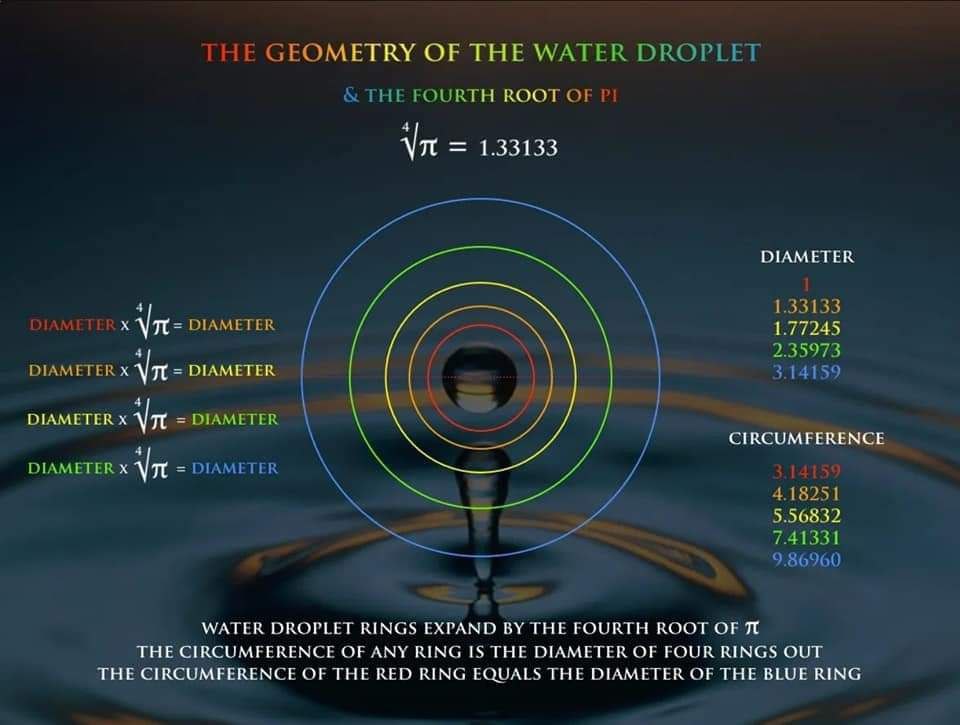
This ripple shows how one small change in slope spreads outward through everything around it.
Think of riding a bike up a hill. A small change in slope feels huge on your legs. Over time, even a slight upward slope changes your destination.
Density, Height, and Time
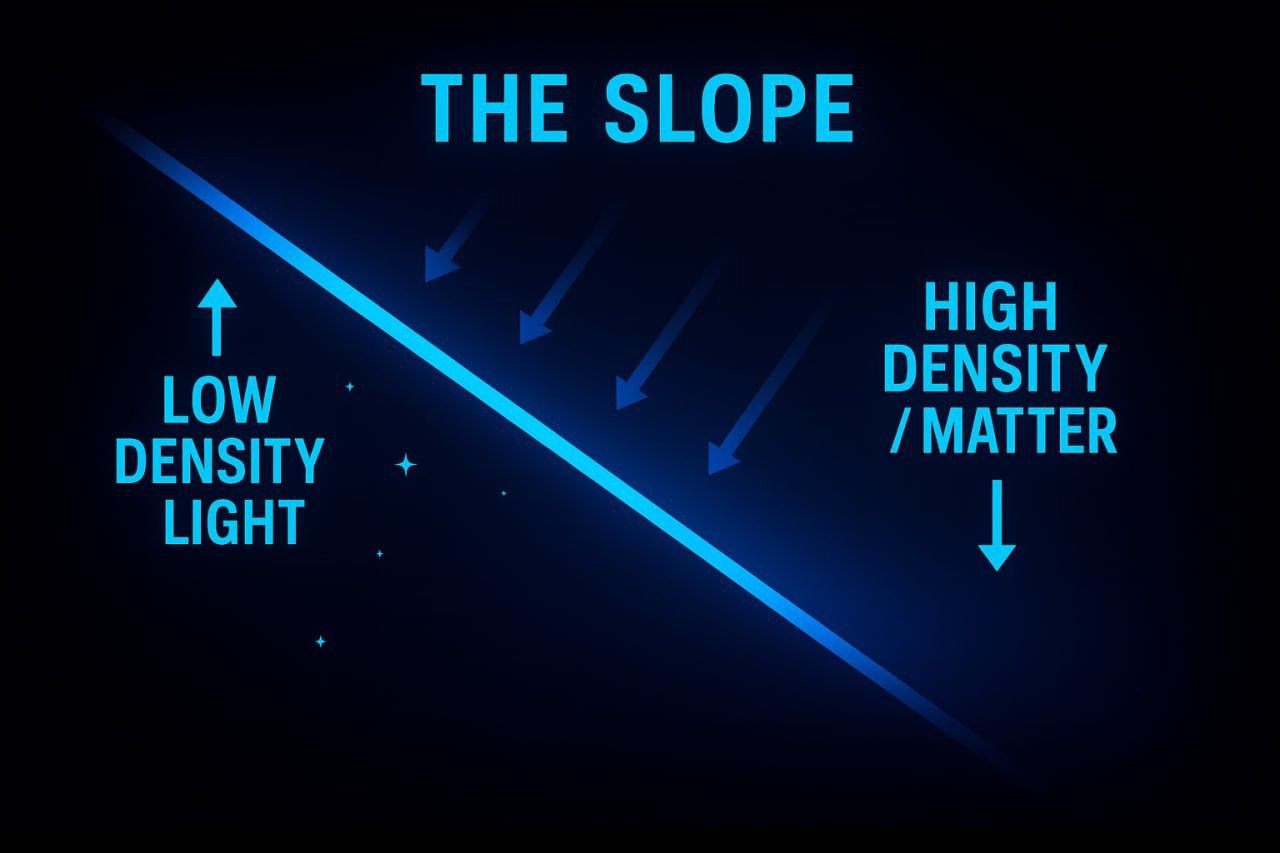
Lower on the slope, density is higher and feels heavier. Higher up, density is lower and feels lighter.
Time example: Closer to the ground, time runs slightly slower. Higher in the air (like in a plane), time moves a tiny bit faster. That difference is small but real, which is why timekeeping and navigation systems apply corrections so everything stays synchronized when you land.
Oxygen example: At lower altitude, oxygen molecules are more packed together, so breathing feels easier. High on mountains like Everest, the air is thinner — the molecules are spread out — so it is harder to get the oxygen your body needs to stay balanced.
How Slope Works in Life
Every system has a slope. Your life has a slope.
Downhill Slope
- You woke up calm
- You made aligned choices
- Alignment created more alignment
- Now you're gliding on a downhill slope
- Momentum feels easy and smooth
Uphill Slope
- You woke up stressed
- You made stressed choices
- Stress created more stress
- Now you're pushing uphill
- Momentum feels heavy and slow
The 3-4-5 Triangle Shows Your Options
You can't skip the 4. The action is what changes the slope.
Why This Matters
You can't think your way to a new slope. You have to MOVE your way there.
When you take small aligned actions (the 4), you shift the angle. After enough actions, you're on a completely different trajectory.
The 36-day journey uses this principle. Every action day (6, 15, 24, 33) is you actively changing your slope.
Checkpoint Quiz
If the rise is 4 and the run is 3, what is the slope?
The 36-Day Journey
Applying slope to your life
Read
See how declaration, action, and result map to 3-4-5.
Try
Click the 36-day map and set a start date.
Reflect
Notice how key action days keep the slope alive.
The 36-Day Journey IS the 3-4-5 Triangle Applied
Your Declaration
Your starting point, your honest truth. What do you want? Be clear. This is the base of your triangle.
Your Action
You don't just think it — you DO it. Every action day (6, 15, 24, 33) you take a real step. This is the climb.
Your Result
If you stay on the slope for 36 days, you arrive. This is the destination.
Journey Cards: See the Pattern
Use these cards as visual anchors. Move through them in order, then click any image to view it full size.
How the 36-Day Pattern Works
The journey follows the 3‑6‑9 rhythm. Every third day is a key day. The days between are integration days — you stay aligned, but you don’t force the slope.
Your starting structure. Day 1 is your declaration, then the first 3‑6‑9 rhythm begins.
Your pattern lock‑in. A pattern needs two cycles to stick — this second 9 seals it.
The mirror phase. You repeat the same rhythm, but now you are being watched — like teaching a skill: first you do it, then it does it.
It takes 18 days to create a structure the Field can follow. The next 18 days repeat the same pattern, but now it is mirroring you.
After you choose a start day, you lock in a new 36‑day pattern. Every day counts, but you only act on every 3rd day.
Light to Matter (18-Day Shape)
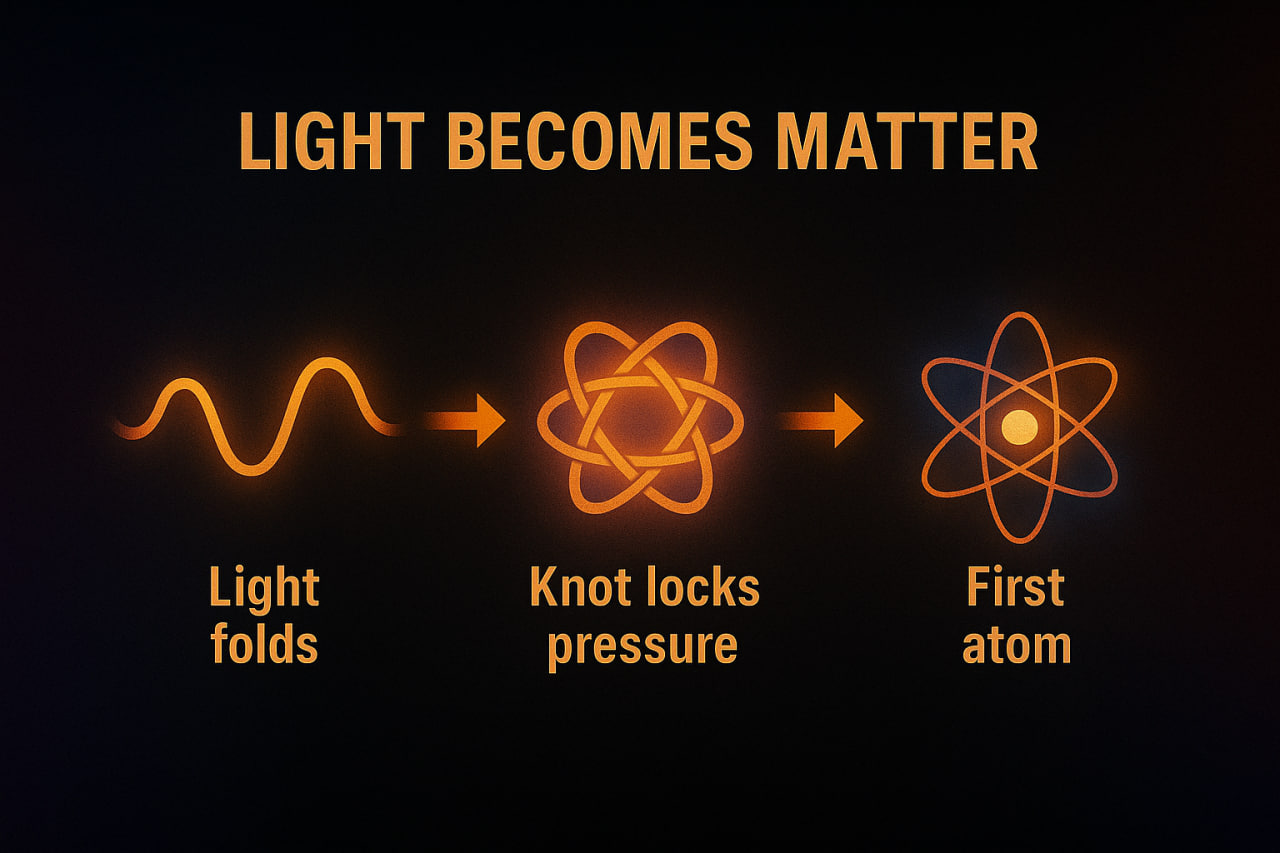
String theory proposes there are unlimited strings around you at all times. When these strings interact with each other, matter is created — light to matter. Light strings are not physical strings, so they can pass within each other.
Each curve of the shape you see is either a day 3, 6, or 9. One full shape is 18 days — the same exact shape of an atom. Are you seeing it now?
Exercise: Place your finger on one curve, follow it down until you reach another curve, then follow to another, and another until you have curved 6 times — like tracing.
The Structure
Day 1 is your declaration: “In 36 days I will…” Then the rhythm begins. On key days you add layers; on the in‑between days you integrate.
Day 1 — Declaration: Write it clearly.
Day 3, 12, 21, 30 — Affirmation days: Read your declaration, then your affirmation (why this journey matters).
Day 6, 15, 24, 33 — Action days: Read declaration + affirmation, then perform your action.
Day 9, 18, 27, 36 — Amplification days: Declaration + affirmation + action, then your amplified action.
Starting Structure
- Day 1: Declaration — “In 36 days I will…”
- Day 3: Affirmation day
- Day 6: Action day
- Day 9: Amplification day
Pattern Lock‑In
- Day 12: Affirmation day
- Day 15: Action day
- Day 18: Amplification day
- Two 9‑day cycles lock the rhythm in
Mirror Phase
- Day 21: Affirmation day
- Day 24: Action day
- Day 27: Amplification day
- The Field can now follow your structure
Field Lock‑In
- Day 30: Affirmation day
- Day 33: Action day
- Day 36: Amplification day
- You repeat the same pattern, but now it repeats you
Interactive 36-Day Map
Click on any day to see what's happening. Highlighted days are your key pattern days.
Click a day above to see its significance.
Why It Works
Pattern Needs Two
A pattern doesn’t lock on the first pass. The second 9‑day cycle seals it, so the rhythm becomes real.
18 + 18 Mirror
The first 18 days create the structure. The next 18 days repeat it while the Field mirrors and learns it.
Every 3rd Day
Affirm, act, amplify. The rhythm is simple and consistent, so your system can follow it without drift.
Checkpoint Quiz
Which days are the main action days in the 36‑day journey?
The Complete Connection
How everything links together
Read
Follow the chain from 3-6-9 to the 36-day journey.
Try
Trace each step and say it out loud in your own words.
Reflect
See the whole system as one continuous spine.
What It All Means
You're not fighting chaos. You're not hoping things work out.
You're recognizing the pattern that's already built into reality, aligning your choices with it, and letting momentum do the work.
Do this for 36 days, and the slope becomes unstoppable.
Checkpoint Quiz
Which item comes immediately after Fibonacci in the connection flow?
Key Takeaways
Everything you need to remember
Read
Review the five core ideas in one place.
Try
Pick one idea you can apply today.
Reflect
Decide your next action day and commit to it.
3-6-9 is the foundation.
Everything reduces to it.
Fibonacci is growth.
It shows how systems expand.
The 3-4-5 triangle is stability.
It shows which directions hold.
Slope is momentum.
It shows which way you're heading.
The 36-day journey locks it in.
It's the proof that you believe the pattern enough to act on it.
Checkpoint Quiz
What is the foundation of the entire training?